
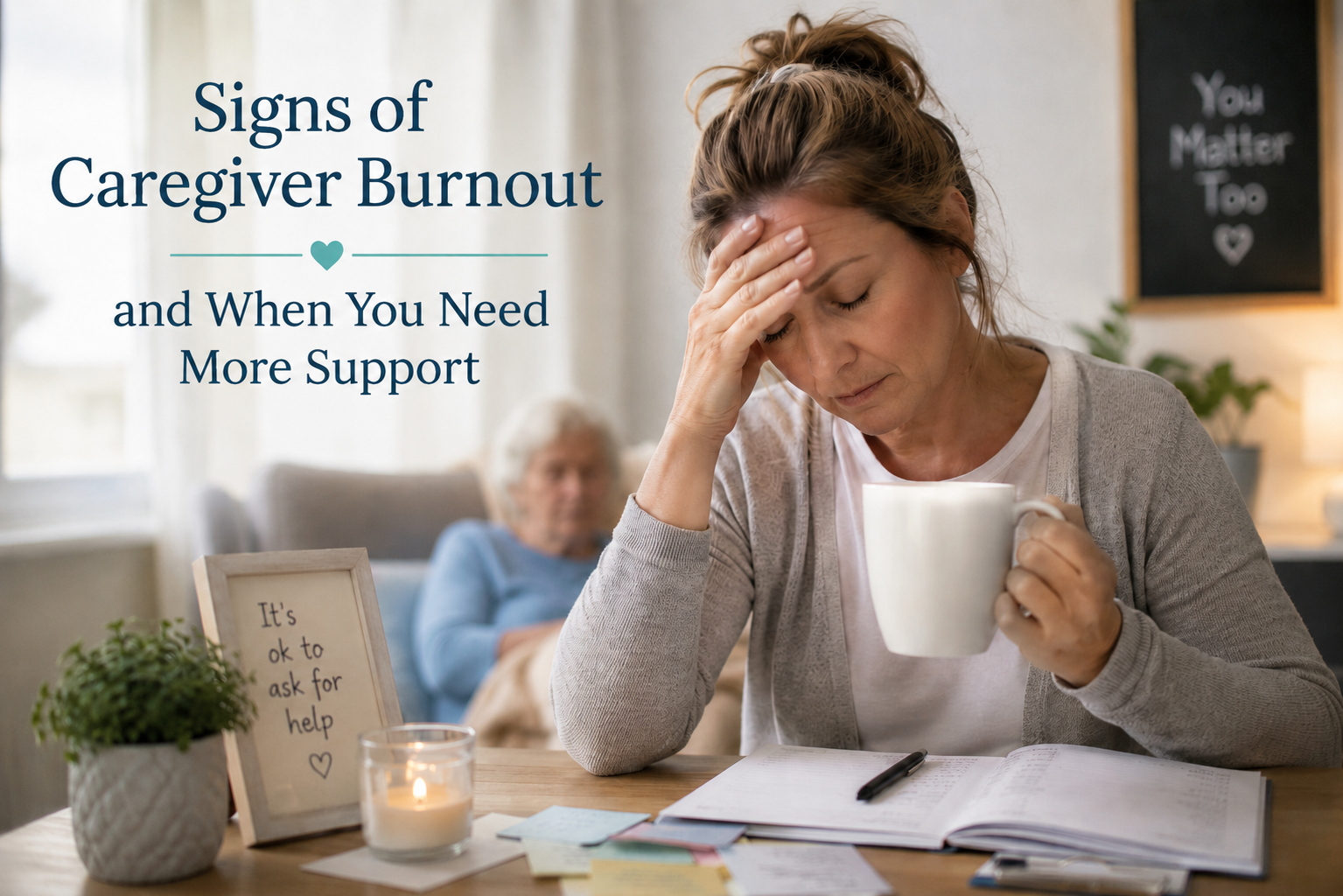
Signs of Caregiver Burnout and When You Need More Support
By Stacey Savarese, RN, BSN, BSW, CCM; Case Manager
Last Updated: June 2026
If you have been caring for an aging parent or spouse and find yourself running on empty, you may be wondering whether what you feel is normal tiredness or something more. Recognizing the signs of caregiver burnout early matters, because burnout affects you and ultimately, others. It affects the quality of care you are able to give your loved one. You are not weak for feeling worn down, and you are not alone. This guide will help you spot the warning signs and understand when it is time to bring in more support.
Caregiving is one of the most loving things a person can do, and also one of the most demanding. Let’s walk through what burnout actually looks like and what your next step might be.
Quick Answer
The clearest signs of caregiver burnout is exhaustion that rest no longer relieves and a resentment-then-guilt cycle that leaves you feeling like there is no way to get a real break.
Burnout is different from ordinary physical tiredness, which lifts after sleep. If feeling depleted lasts weeks, is affecting your own health, or is changing how you care for yourself, then it is time to bring in more support through respite care, family help, or local caregiver services. The self-check below can help you tell where you stand.
Burnout Versus Ordinary Tiredness
Most caregivers are tired. The question this guide helps you answer is whether you have crossed from tired into burned out, because the two call for different responses. Ordinary tiredness lifts after a good night’s sleep or a quiet weekend. Burnout does not. It is the kind of depletion that rest no longer seems to reach, paired with a sense that there is little left of you to give anyone.
The reason this line is so easy to miss is that you rarely cross it in a single day.
It builds.
It happens one skipped meal, one interrupted night, and one canceled plan at a time, until the new normal feels like just how things are.
The self-check below is meant to help you step back and see the pattern honestly. For a deeper look at why this happens, and why it is not your fault, see our companion article on caregiver burnout as a system failure.
A Quick Caregiver Burnout Self-Check
Rather than scanning a list of symptoms, it can help to ask yourself a few honest questions about the last few weeks. Read through these slowly. The goal is not a score or a diagnosis. It is to notice whether a pattern has quietly taken hold.
- When I finally do rest, do I still wake up feeling depleted rather than restored?
- Have I let my own appointments, meals, or basic care slide while keeping up with my loved one’s?
- Am I shorter-tempered than I want to be, with my loved one or with the people around me?
- Have I quietly dropped the friendships, hobbies, or routines that used to feel like mine?
- Do I feel resentment building, then a wave of guilt for feeling it at all?
- Am I leaning on extra coffee, a glass of wine, or food just to get through the day?
- Does it feel like there is no version of this where I get a real break?
If you found yourself nodding at several of these, especially the ones about rest that does not restore and the resentment-then-guilt cycle, that is worth taking seriously.
These are not signs that you are doing a bad job.
They are signs that you have been doing a hard job without enough support, for longer than anyone should have to.
It is a signal that the load needs to be shared.
Who Is Most at Risk for Caregiver Burnout?
Burnout can affect any caregiver, but some situations carry more risk. Knowing whether you are in a higher-risk situation can help you act before things reach a crisis.
- Caregivers doing it alone, without other family members sharing the load.
- Those caring for someone with Dementia, which often demands constant supervision.
- Caregivers who live with the person they care for, where there is little separation between care and rest.
- People balancing caregiving with another job or raising their own children.
- Caregivers who struggle to ask for help, often out of guilt or a sense of duty.
When to Get More Support
It can be hard to know when normal stress has crossed into something that needs action. A good rule of thumb: if burnout symptoms have lasted more than 2 weeks, are affecting your own health, or are changing the way you care for your loved one, it is time to bring in more help.
You do not have to wait until you hit a wall.
Signs it is time to act now
- You feel you cannot keep going the way things are.
- Your own physical or mental health is clearly declining.
- You feel detached from your loved one, or dread caring for them.
- You have had thoughts of hurting yourself, or fears that you might harm or neglect your loved one.
That last point deserves special attention. If you are having thoughts of harming yourself, please reach out for help right away. In the United States, you can call or text 988 to reach the Suicide and Crisis Lifeline at any time. Reaching out is a sign of strength, and support is available.
Asking for more support is not the same as giving up on caring for your loved one. When I work with caregivers, we are constantly trying to bring in help. This help can be either formal respite, family, or paid services.
It is often what allows a caregiver to keep going at all. Sharing the load protects both of you.
Granted, this gets complicated when the patient does not want people in the home.
Ways to Get More Support as a Caregiver
The good news is that you have real options, and many of them are local. Relief can come from family, from community programs, and from professional services. You do not have to use all of them at once. Even one change can ease the pressure.
- Respite care. Short-term care that gives you a planned break, from a few hours to a few days.
- Sharing tasks with family. Errands, rides, meals, and paperwork can often be handed off to relatives.
- In-home help. Non-medical home care or home health services can take on personal care and supervision.
- Adult day programs. Daytime care and socialization for your loved one, and breathing room for you.
- Caregiver support groups. Talking with people who understand reduces isolation and stress. These are both in person and even virtual now.
- Your own healthcare. Keep your own appointments and tell your doctor how you are really doing.
Philadelphia and Surrounding County Caregiver Support
Families in Philadelphia, Bucks County, Montgomery County, Delaware County, and Chester County have access to local programs built to support caregivers, not just the people they care for. These services can take real tasks off your plate and give you room to recover.
- Philadelphia Corporation for Aging (PCA). The local gateway to in-home services, caregiver support, and respite for Philadelphia residents. Other counties have their own Area Agency on Aging.
- Respite care services. Planned short-term relief so you can rest, work, or simply step away.
- Adult day programs and in-home care. Daytime or in-home support across the five counties.
- Caregiver support groups. Local and virtual groups where you do not have to explain why you are tired.
- The GUIDE Program. A new initiative to provide support for caregivers caring for those with cognitive decline and needs.
You can find providers and programs across all five counties in The Caregivers Directory Senior Services Directory, including the Caregiver Support category. For trustworthy national guidance on caregiver health and burnout, the National Institute on Aging is a good place to start.
Related Resources
Recognizing burnout is the first step. The next is letting yourself accept help, which is often the hardest part. When you are ready, read our companion guide on how to ask for help as a caregiver without feeling guilty for practical ways to start sharing the load.
Take the first step today
If you recognize yourself in these signs, download our free Caregiver Burnout Triage Checklist.
It helps you quickly gauge your actual stress level and points you toward the kind of support that fits your situation.
You can also explore the Senior Services Directory to find respite care, in-home help, adult day programs, and caregiver support throughout Philadelphia and the surrounding counties.
Frequently Asked Questions
What are the first signs of caregiver burnout?
The most telling early sign is exhaustion that a good night’s sleep no longer fixes. Many caregivers also notice the resentment-then-guilt cycle, feeling a flash of frustration and then blaming themselves for it, along with quietly dropping their own routines and friendships. Catching this pattern early makes it easier to get support before reaching a crisis.
Is caregiver burnout the same as depression?
They can overlap and share symptoms like exhaustion, sadness, and hopelessness, but they are not the same thing. Burnout is tied specifically to the demands of caregiving. If low mood, hopelessness, or loss of interest last more than a couple of weeks, it is worth talking with your doctor, since depression may also be present and is treatable.
How do I take a break from caregiving?
Respite care is designed for exactly this. It provides short-term care for your loved one, from a few hours to several days, so you can rest. Sharing tasks with family, using adult day programs, or bringing in in-home help can also build regular breaks into your week.
Where can I find caregiver support near me in Philadelphia?
Start with the Philadelphia Corporation for Aging, or your county’s Area Agency on Aging in Bucks, Montgomery, Delaware, or Chester County. You can also find respite care, in-home help, and support groups in The Caregivers Directory.
What should I do if caregiving feels like too much?
Reach out for support sooner rather than later, through family, respite care, or local services. If you are having thoughts of harming yourself or feel you cannot keep your loved one safe, call or text 988 right away to reach the Suicide and Crisis Lifeline. Asking for help is a sign of strength.
Medical and Informational Disclaimer
The Caregivers Directory provides general information and resources for educational purposes only. The content on this site, including this article, is not medical, legal, or financial advice and should not be used as a substitute for guidance from a qualified physician, licensed healthcare provider, attorney, or financial professional. If you are experiencing emotional distress or a mental health crisis, contact a qualified professional, or call or text 988 in the United States to reach the Suicide and Crisis Lifeline. Program availability, eligibility requirements, accepted insurance plans, services offered, and areas served may change over time. Always contact providers, agencies, and government programs directly to confirm current details before making care decisions. If you believe your loved one is experiencing a medical emergency, call 911 immediately.